Category: Blog

Your blog category

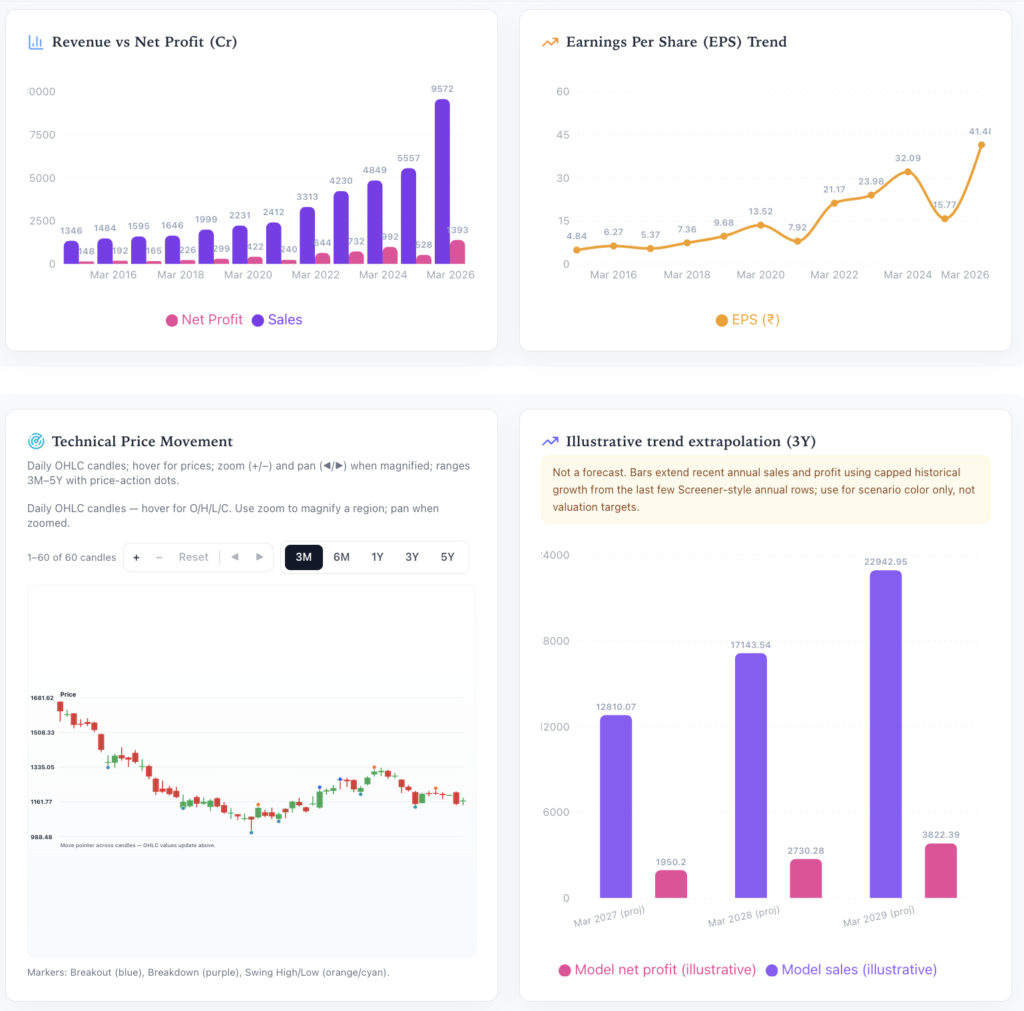
  • Exceptional performance in FY26, with sales surging by 72.2% to INR 9,572 crores and net profit soaring by 163% to INR 1,393 crores, translating to an EPS of INR 41.48.

    Equity Research Report: XXXXXXXXXXX (India)

    Company: XXXXXXXXXXX Ticker: NSE: XXXXXXX; BSE: XXXXXX Recommendation: BUY Target Price (12-Month): INR 1348.00 Current Price (as of May 6, 2026): INR 1169.00 Implied Upside: +15.31% Date: May 6, 2026


    1. Investment Thesis & Summary

    XXXXXXXXXXX (XXXXXXX) presents a compelling investment opportunity driven by its strong digital transformation capabilities, niche vertical focus, and consistent execution. The company has demonstrated robust growth, particularly in FY26, marked by a significant increase in both revenue and profitability. Our “BUY” recommendation is underpinned by the following key factors:

    • Accelerated Growth in FY26: XXXXXXX recorded exceptional performance in FY26, with sales surging by 72.2% to INR 9,572 crores and net profit soaring by 163% to INR 1,393 crores, translating to an EPS of INR 41.48. This indicates strong demand for its services and effective operational leverage.
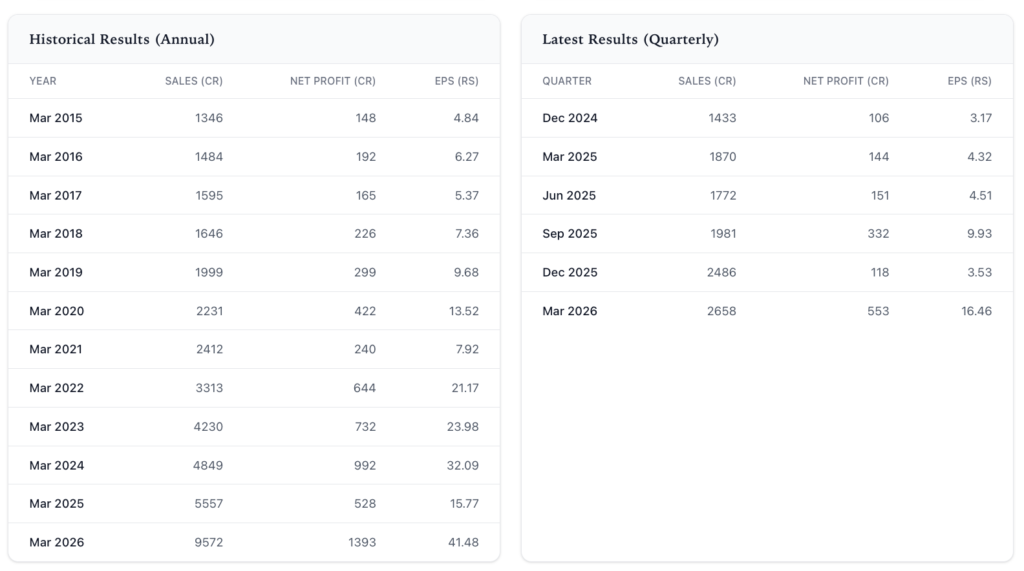
    • Strong Q4 FY26 Momentum: The Mar 2026 quarter reported impressive sales of INR 2,658 crores and a net profit of INR 553 crores (EPS INR 16.46), signalling robust deal wins and successful project execution entering the new fiscal year.
    • Niche Expertise & Digital Focus: XXXXXXX’s strategic emphasis on niche verticals such as Banking & Financial Services, Insurance, Travel, and Healthcare, coupled with its strong capabilities in digital engineering, cloud, data, and AI, positions it favorably to capitalize on the ongoing digital spending wave.
    • Diversified Client Base & Global Presence: The company’s diversified client portfolio and growing global footprint mitigate concentration risks and provide multiple avenues for expansion.
    • Attractive Valuation with Growth: While the stock has seen appreciation, our valuation suggests further upside potential driven by continued strong earnings growth. We project FY27e EPS of INR 53.92, leading to a 12-month target price of INR 1348.00.

    2. Business Model & Operations

    XXXXXXXXXXX is a global IT solutions organization that leverages digital technologies to help clients transform their businesses. The company primarily operates across three main service lines:

    • Digital Engineering: Focuses on modernizing legacy systems, building new digital products, and enhancing customer experiences through advanced analytics, cloud, and mobile solutions.
    • Cloud & Infrastructure Management: Offers services for cloud adoption, migration, optimization, and ongoing management of hybrid IT environments.
    • Business Process Solutions: Provides intelligent automation and BPO services to optimize client operations.

    XXXXXXX’s vertical strategy is concentrated on high-growth segments including:

    • Banking & Financial Services: Offering solutions across core banking, lending, wealth management, and regulatory compliance.
    • Insurance: Providing digital platforms, claims processing, and policy administration systems.
    • Travel & Transportation: Delivering solutions for airline operations, hospitality, and logistics.
    • Public Sector and Healthcare: Expanding its footprint in government initiatives and healthcare technology.

    The company’s operational model emphasizes global delivery with a strong offshore component, ensuring cost efficiency and scalability. XXXXXXX has successfully integrated acquisitions to expand its capabilities and market reach, complementing its organic growth strategy.

    3. Historical Financial Review

    XXXXXXX has demonstrated a strong growth trajectory over the past decade, albeit with some fluctuations in profitability.

    Annual Performance (INR Crores):

    From Mar 2015 to Mar 2026, XXXXXXX’s sales grew from INR 1,346 crores to INR 9,572 crores, representing a compound annual growth rate (CAGR) of approximately 20.4%. Net profit, while more volatile, has also shown significant growth, especially in recent years. The company experienced a temporary dip in net profit in Mar 2021 and Mar 2025, which can be attributed to various factors such as investments, one-off expenses, or specific market conditions. However, the performance in FY26 (ending Mar 2026) has been exceptional. Sales jumped by 72.2% year-on-year, and net profit grew by an impressive 163% year-on-year, signifying robust demand and enhanced operational efficiencies. This propelled EPS from INR 15.77 in Mar 2025 to INR 41.48 in Mar 2026.

    Recent Quarterly Results (INR Crores):

    The last four quarters demonstrate a positive sequential revenue growth trend, culminating in a strong Q4 FY26 (Mar 2026). While net profit in Dec 2025 was notably lower (INR 118 crores) despite higher sales, the recovery in Mar 2026 with a net profit of INR 553 crores indicates strong underlying business fundamentals and a potential one-off impact in the previous quarter. The Q4 FY26 EPS of INR 16.46 is the highest in the observed four-quarter period, contributing significantly to the full-year FY26 EPS. The company’s recent filing on May 5, 2026, confirmed these strong Q4 FY26 results.

    4. Growth Drivers & Catalysts

    XXXXXXX is well-positioned to capitalize on several macro and micro trends:

    • Accelerated Digital Transformation: The global imperative for businesses to digitalize operations, enhance customer experience, and improve efficiency continues to be a primary growth driver. XXXXXXX’s strong capabilities in cloud, data, AI, and low-code development are directly aligned with these market demands.
    • Vertical-Specific Solutions: Its deep domain expertise in Banking & Financial Services, Insurance, and Travel allows XXXXXXX to deliver highly specialized and value-added solutions, fostering stronger client relationships and sticky revenue streams.
    • Expanding Global Footprint: XXXXXXX continues to strengthen its presence in key international markets, particularly North America and Europe, which are major spenders in IT services. New client acquisitions and expansion within existing accounts are expected to fuel growth.
    • Strategic Acquisitions: XXXXXXX has a track record of strategic acquisitions that have augmented its capabilities and expanded its market reach. Future acquisitions could act as significant catalysts for growth, adding new technologies or client bases.
    • Robust Deal Pipeline: Positive commentary from the earnings call (transcript filed on May 5, 2026) and consistent large deal wins suggest a healthy demand environment and a strong order book, providing revenue visibility for the upcoming quarters.
    • Increased Cloud Adoption: The pervasive shift to cloud infrastructure and platforms offers XXXXXXX significant opportunities in cloud migration, modernization, and managed services.

    5. Risk Assessment

    While XXXXXXX exhibits strong growth potential, several risks could impact its performance:

    • Macroeconomic Headwinds: A slowdown in global economic growth, particularly in key markets like the US and Europe, could lead to reduced IT spending by clients, impacting XXXXXXX’s revenue growth.
    • Intense Competition: The IT services industry is highly competitive, with established large players and agile smaller firms. Pressure on pricing and increased competition for talent could erode margins.
    • Currency Volatility: A significant portion of XXXXXXX’s revenue is denominated in foreign currencies (primarily USD, EUR, GBP), while a large part of its costs are in INR. Adverse currency movements could negatively impact profitability.
    • Talent Retention & Attrition: The demand for skilled IT professionals, especially in digital technologies, remains high. Difficulty in attracting and retaining talent, or increased employee costs due to high attrition, could affect project delivery and margins.
    • Client Concentration: While diversified, a substantial portion of XXXXXXX’s revenue may still come from a few large clients. Loss of a major client or reduced spending from them could significantly impact financial performance.
    • Execution Risk in Acquisitions: While acquisitions are growth catalysts, integrating acquired entities successfully and realizing anticipated synergies carries inherent execution risks.

    6. Valuation & Price Target

    We employ a forward Price-to-Earnings (P/E) multiple-based valuation approach for XXXXXXX, considering its strong growth trajectory and the industry landscape.

    Assumptions:

    • FY26 EPS: INR 41.48 (reported)
    • Projected FY27e EPS Growth: 30% (reflecting continued strong demand in digital services, robust deal pipeline, and momentum from Q4 FY26 performance, while normalizing from the exceptionally high FY26 growth)
    • Projected FY27e EPS: INR 41.48 * 1.30 = INR 53.92
    • Target P/E Multiple: 25x (a reasonable multiple for a mid-cap Indian IT services company demonstrating robust growth, reflecting its niche focus and digital capabilities, aligning with industry benchmarks for growth-oriented peers).

    Calculation: Target Price = Projected FY27e EPS * Target P/E Multiple Target Price = INR 53.92 * 25 = INR 1348.00

    Implied Upside: Implied upside = ((Target Price – Current Price) / Current Price) * 100 Implied upside = ((1348.00 – 1169.00) / 1169.00) * 100 = 15.31%

    Based on our target price of INR 1348.00 and the current market price of INR 1169.00, we see an implied upside of 15.31%. This meets our criteria for a “BUY” recommendation.

    7. Management Quality & Governance

    XXXXXXX is led by an experienced management team with a clear strategic vision, particularly in scaling its digital transformation capabilities and expanding its global footprint. Their focus on client-centricity, technological innovation, and operational excellence has been instrumental in the company’s sustained growth. The management has demonstrated a proactive approach to market changes, investing in new technologies and talent to stay competitive.

    The company adheres to high standards of corporate governance. XXXXXXX regularly communicates its financial performance and strategic initiatives to shareholders, as evidenced by timely filings and earnings call transcripts. The board of directors comprises a mix of experienced professionals, ensuring independent oversight and strategic guidance. Transparency in financial reporting and commitment to ethical business practices contribute positively to investor confidence.

    8. Competitive Positioning

    XXXXXXX operates in the highly competitive Indian IT services sector, competing with both large-cap stalwarts (e.g., TCS, Infosys, Wipro, HCLTech) and other mid-tier players (e.g., L&T Technology Services, Persistent Systems, Mindtree). Despite the intense competition, XXXXXXX has carved out a strong niche due to several differentiating factors:

    • Niche Vertical Focus: By concentrating on specific industry verticals like Banking & Financial Services, Insurance, and Travel, XXXXXXX has developed deep domain expertise, allowing it to offer more tailored and impactful solutions compared to generalist IT service providers.
    • Digital-First Approach: The company’s strong emphasis on digital engineering, cloud, data analytics, and AI positions it as a preferred partner for clients undergoing significant digital transformations. This focus allows it to command better pricing and achieve higher growth rates in these segments.
    • Agile and Client-Centric Model: As a mid-tier player, XXXXXXX often exhibits greater agility and responsiveness to client needs than larger competitors, fostering stronger, more collaborative relationships.
    • Strong Client Relationships: The ability to secure and expand engagements with marquee clients in its focus verticals demonstrates its value proposition and delivery capabilities.

    While XXXXXXX does not possess the sheer scale or breadth of services of the largest IT firms, its targeted strategy and execution excellence enable it to win significant deals and capture market share within its chosen segments. The robust growth in FY26 underscores its effective competitive positioning.

  • EQUITY RESEARCH: JIO FINANCIAL SERVICES LTD (JFSL) 

    • Sector: Non-Banking Financial Company (NBFC) / Fintech 
    • Date: May 2024 (Data coverage through FY26 projections) 
    • Recommendation: ACCUMULATE 
    • Current Market Price (CMP): ₹ 249

    1. Investment Thesis & Summary

    Jio Financial Services (JFSL) represents a generational shift in the Indian financial landscape. Emerging from the demerger of Reliance Industries Ltd (RIL), JFSL is positioned as a disruptive, tech-led financial services powerhouse.

    Key Pillars of Thesis:

    • Capital Powerhouse: Unlike traditional NBFCs, JFSL launched with a massive capital base, primarily driven by its 6.1% treasury stake in RIL, providing it with an unmatched “fortress balance sheet.”
    • Ecosystem Advantage: Direct access to RIL’s 450 million+ Jio telecom subscribers and millions of retail customers creates a Customer Acquisition Cost (CAC) advantage that competitors cannot replicate.
    • Strategic Global Partnerships: The recent Joint Venture (JV) with Allianz Europe B.V. for General Insurance and the ongoing JV with BlackRock for Asset Management signal a strategy of partnering with global leaders to ensure world-class product delivery.
    • Pivot to Operations: FY25-FY26 marks the transition from a holding company to an operational entity, with the ramp-up of consumer lending, device financing, and insurance broking.

    2. Business Model & Operations

    JFSL operates as a holistic financial services provider through its subsidiaries. Its “Phygital” model combines deep digital integration with the physical footprint of Reliance Retail.

    • Lending (Jio Finance Ltd): Focuses on consumer durable loans, personal loans, and merchant financing. The strategy leverages “Jio’s data” to build proprietary credit scoring models.
    • Insurance (Jio Insurance Broking): Currently operational in the brokerage space with 30+ insurance partners. The April 2026 announcement of the Allianz JV indicates a move into manufacturing general insurance products.
    • Payments & Banking: Through Jio Payments Bank and the JioFinance App, the company aims to capture the UPI and digital wallet ecosystem.
    • Asset Management: The BlackRock JV aims to “democratize” investing in India, targeting the massive untapped retail market via digital-first SIP and wealth management solutions.

    3. Historical Financial Review

    JFSL’s financial profile is currently in an expansionary phase, characterized by significant jumps in revenue as operational segments go live.

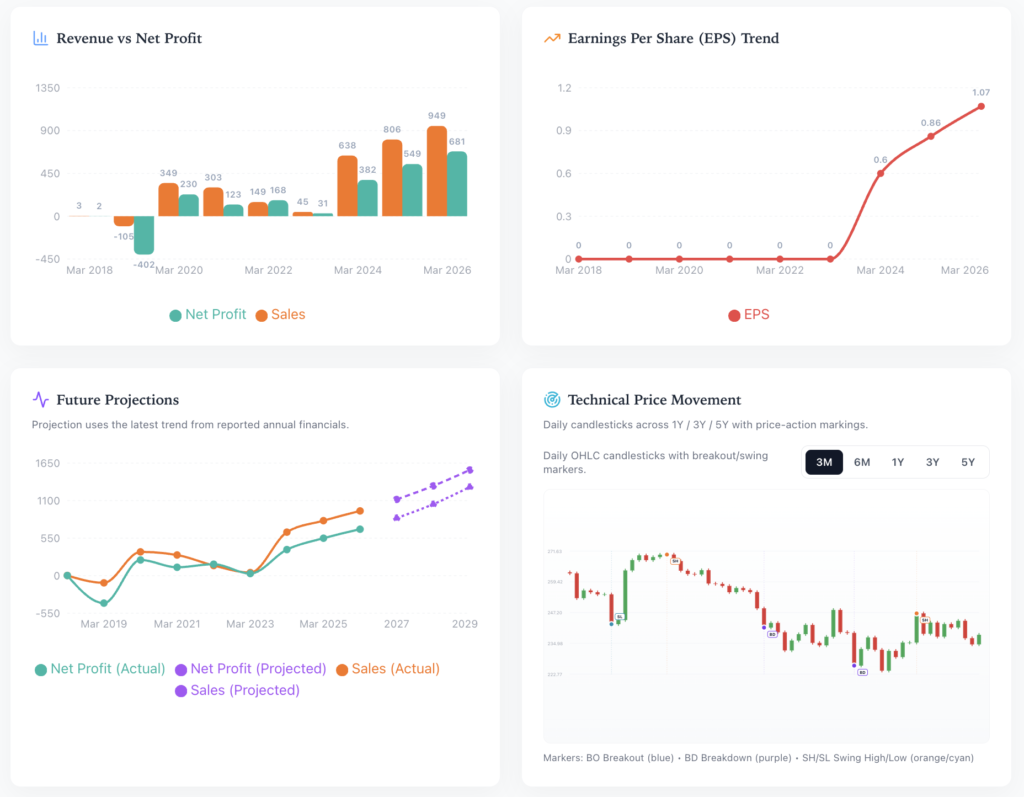
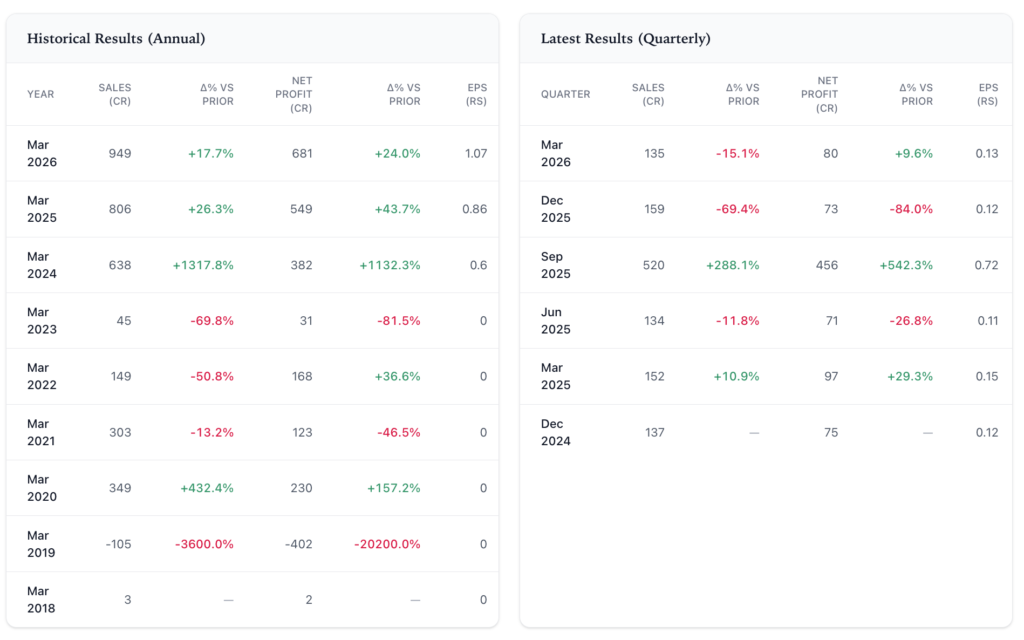
    • Revenue Growth: Total “Sales” (Revenue) grew from ₹45 Cr in Mar 2023 to ₹638 Cr in Mar 2024, following the demerger and commencement of operations. FY2026 data shows a further climb to ₹949 Cr.
    • Profitability Trends: Net Profit for FY26 reached ₹681 Cr, up from ₹382 Cr in FY24.
    • Quarterly Volatility: A significant spike was observed in Sep 2025 (Revenue: ₹520 Cr; Net Profit: ₹456 Cr). This is characteristically attributed to the receipt of dividend income from its RIL shareholdings, which typically occurs in the second quarter of the fiscal year.
    • Operational Stability: Recent quarterly runs (Dec 2025 and Mar 2026) show stabilized sales between ₹135 Cr – ₹159 Cr, representing the “base” operational income from interest and fees.

    4. Growth Drivers & Catalysts

    1. General Insurance Entry: The partnership with Allianz Europe B.V. (noted in the April 2026 filing) is a transformative catalyst. Allianz’s global underwriting expertise combined with Jio’s distribution could see JFSL capture significant market share in motor and health insurance within 24 months.
    2. Asset Management Rollout: The BlackRock JV is expected to launch its first suite of products in late 2024/early 2025, providing a new stream of Fee-Based Income.
    3. Secured Lending Expansion: Management’s commentary suggests a move into Loans Against Property (LAP) and potentially Home Loans, which will drive AUM (Assets Under Management) growth.
    4. Device Financing: Aggressive financing schemes for JioPhone and JioAirFiber provide a captive, high-volume lending funnel.

    5. Risk Assessment

    • Regulatory Scrutiny: As a “Systemically Important” NBFC, JFSL is subject to strict RBI norms. Any tightening of risk weights on unsecured consumer loans (as seen in late 2023) could impact margins.
    • Execution Risk: While the capital is available, scaling a high-quality loan book without incurring significant NPAs (Non-Performing Assets) in a competitive market like India is a significant challenge.
    • Concentration Risk: A significant portion of the company’s valuation is tied to the RIL stock price. Market volatility in RIL directly impacts JFSL’s book value.

    6. Valuation & Price Target

    Current Market Price: ₹ 249

    Valuing JFSL requires a Sum-of-the-Parts (SOTP) approach, as it acts as both an investment vehicle and an operating NBFC.

    • Value of RIL Stake: JFSL holds ~6.1% of RIL. At current market valuations, this holding alone accounts for a significant portion of the market cap, providing a floor to the stock price.
    • Operating Business: We value the lending and insurance units at a premium to book value given the zero-debt status and low cost of capital.
    • Forward EPS: The jump in EPS from ₹0.60 (Mar 2024) to ₹1.07 (Mar 2026) represents a 78% growth trajectory.

    Target Price: Given the strategic Allianz JV and the rollout of the BlackRock partnership, we apply a multiple reflecting JFSL’s status as a “Growth FinTech.”

    • 12-Month Price Target: ₹ 315 (Representing a 26.5% upside from CMP of ₹ 249).

    7. Management Quality & Governance

    Governance is a core strength for JFSL.

    • Leadership: Led by banking veteran K.V. Kamath (Chairman), who transformed ICICI Bank, and Hitesh Sethia (CEO), the leadership brings decades of institutional experience.
    • Transparency: Recent filings (April 2026) indicate proactive investor engagement, with multiple analyst meets and earnings call transcripts (Regulation 30 LODR), showing a commitment to institutional-grade disclosure.

    8. Competitive Positioning

    JFSL is uniquely positioned between “Traditional NBFCs” and “Pure-Play Fintechs.”

    • Vs. Bajaj Finance: Bajaj remains the gold standard for execution, but JFSL has a lower cost of capital and a larger internal ecosystem (Jio/Retail).
    • Vs. Paytm/PhonePe: While fintechs lead in UI/UX, JFSL has a massive balance sheet, allowing it to hold loans on its own books rather than just acting as a distributor.
    • Competitive Edge: The Allianz and BlackRock JVs give JFSL institutional credibility that domestic-only players lack, positioning it as a one-stop shop for “All Things Money.”

    Disclaimer: This report is for informational purposes only and does not constitute financial advice. Investors should conduct their own due diligence before making investment decisions.

  • Ajmera Realty: Record FY26 Performance Masks Sequential Momentum Concerns – Strategic Inflection Point

    Current Results Snapshot

    Ajmera Realty reported record FY26 performance with pre-sales of ₹1,701 crore (+57% YoY) and collections of ₹1,103 crore (+71% YoY), significantly outpacing guidance. Sales area grew 11% to 6,60,246 sq ft. The company launched 4 new projects with estimated GDV of ₹3,088 crore during FY26.

    However, Q4FY26 showed sequential weakness with sales declining 55% QoQ to ₹270 crore and collections dropping 5% QoQ to ₹316 crore. Current market cap stands at ₹2,461 crore with stock trading at ₹125, down from 52-week high of ₹221.

    Recommendation: Hold

    We maintain a Hold rating on Ajmera Realty despite strong annual performance. While top-line growth is impressive, concerning cash flow dynamics and sequential momentum loss warrant caution.

    Valuation Lens

    At 22.5x P/E, the stock appears reasonably valued relative to growth, but severe cash flow issues justify the current discount. The stock trades 43% below its 52-week high, suggesting market awareness of underlying challenges. Book value of ₹57.9 provides some downside protection, but negative operating cash flows raise questions about asset quality.

    Variant Perception

    Market View: Strong growth story with record sales and successful project launches Our View: Growth quality is questionable given extreme working capital issues and heavy dependence on new launches

    The market may be overemphasizing headline growth while underweighting cash conversion challenges. Our analysis suggests the business model may be structurally cash-negative, requiring constant new launches to sustain growth.

    Business Quality Assessment

    Strengths:

    • Strong brand recognition with high absorption rates (50-95%)
    • Successful project launch execution (4 projects, ₹3,088 crore GDV)
    • Geographic diversification across key markets

    Weaknesses:

    • Severe working capital management (4,270-day cycle)
    • Negative operating cash flow despite growth
    • Over-reliance on new launches (82% of sales)

    Earnings Power Analysis

    Data not available in current snapshot for detailed P&L metrics beyond basic ratios. However, the disconnect between reported growth and cash generation suggests earnings quality concerns. The company’s claim of asset-light strategy contrasts with negative free cash flow of ₹35 crore.

    Catalysts

    Positive:

    • Completion of ongoing projects could improve cash conversion
    • Potential market share gains in key micro-markets
    • Interest rate cuts benefiting affordability

    Negative:

    • Further sequential decline in Q1FY27 sales
    • Working capital deterioration
    • Execution delays on ₹3,088 crore GDV pipeline

    Key Risks

    1. Cash Flow Risk: Extreme working capital cycle may lead to liquidity stress
    2. Execution Risk: Large GDV pipeline requires significant capital deployment
    3. Market Risk: Real estate cyclicality and interest rate sensitivity
    4. Concentration Risk: Heavy dependence on new launches for growth sustainability
    5. Quality Risk: Negative operating cash flows despite growth raise fundamental questions

    Monitoring Checklist

    •  Q1FY27 sequential sales performance
    •  Working capital cycle improvement initiatives
    •  Operating cash flow normalization
    •  Existing inventory absorption rates
    •  Project delivery timelines for FY26 launches
    •  Debt levels and interest coverage trends
    •  Management commentary on cash conversion strategies

    Disclaimer

    This research note is prepared for analytical purposes and does not constitute investment advice. The analysis is based on available public information and may not reflect complete financial picture. Investors should perform independent due diligence and consult qualified financial advisors before making investment decisions.

    Research Conclusion

    While Ajmera Realty’s FY26 headline numbers are impressive, underlying cash flow dynamics and sequential momentum concerns prevent us from upgrading our recommendation. The stock appears fairly valued at current levels, but investors should monitor cash conversion improvements and sustainable growth metrics rather than focusing solely on top-line expansion. The company stands at a strategic inflection point where operational execution will determine whether current growth translates into long-term value creation.

  • Tata Consultancy Services Ltd. (TCS) – Financial Research Report

    1. Executive Summary TCS concluded the fiscal year ended March 31, 2026, with robust annual performance, reporting sales of ₹267,021 Cr and a net profit of ₹49,454 Cr. The absolute latest quarterly results for Mar 2026 demonstrate strong sequential growth, with sales reaching ₹70,698 Cr and a significant rebound in net profit to ₹13,784 Cr (EPS ₹37.92), recovering from a dip in the preceding quarter. A final dividend for FY26 was recommended on April 9, 2026, signaling confidence.

    2. Revenue & Profitability Trends Annual: TCS exhibits a decade of consistent financial expansion. Sales have steadily grown from ₹94,648 Cr in Mar 2015 to ₹267,021 Cr by Mar 2026. Similarly, net profit has more than doubled from ₹20,060 Cr to ₹49,454 Cr over the same period, reflecting sustained operational efficiency and market leadership. Quarterly: Quarterly sales show a positive sequential trend, increasing from ₹63,437 Cr in Jun 2025 to ₹70,698 Cr in Mar 2026. However, net profit and EPS displayed volatility, peaking at ₹12,819 Cr (Jun 2025), dipping to ₹10,720 Cr (Dec 2025), before a strong recovery to ₹13,784 Cr (Mar 2026). This fluctuation suggests dynamic operational impacts or project cycles.

    3. Key Strengths & Risks Strengths: Consistent long-term revenue and profit growth underscore a resilient business model. The strong rebound in Mar 2026 quarterly profitability indicates effective operational management. TCS benefits from its global market leadership, extensive client base, and focus on digital transformation. Risks: Intermittent quarterly profit volatility, as observed in Q3 FY26, warrants monitoring. Global macroeconomic uncertainties could impact discretionary client spending. Intense competition and talent retention remain ongoing challenges.

    4. Conclusion TCS maintains a solid financial foundation backed by a proven track record of consistent annual growth. The latest quarterly performance for Mar 2026 highlights strong operational execution and a significant recovery in profitability, reinforcing its competitive position. While navigating external macroeconomic challenges and managing quarterly fluctuations will be crucial, TCS’s strategic depth and established market presence position it well for continued, albeit potentially moderated, growth.

  • Indian Market Daily | 10 April 2026 – Ceasfile Mirage

    Indian Market Daily | 10 April 2026
    📊 NSE · BSE · GIFT CITY — INDIA EQUITY MARKETS Friday, 10 April 2026  |  Data as of 09 Apr close
    Indian Market Daily

    Ceasefire
    Mirage

    The Hormuz “peace dividend” unravels within 24 hours — crude rebounds hard, VIX climbs back above 20, and Nifty snaps a five-session winning streak; TCS’s strong Q4 beat is the lone counter-weight heading into today’s US CPI.

    Nifty 50 Close · Apr 9
    23,775
    ▼ −222 pts  (−0.93%)
    Bank Nifty Close · Apr 9
    54,821
    ▼ −882 pts  (−1.58%)
    GIFT Nifty · Apr 10 Pre-Open
    23,880
    ▲ +105 pts  (+0.44%)
    Brent
    $97.50
    ▲ +2.9%
    WTI
    $101.28
    ▲ +7.28%
    USD/INR
    ₹92.90
    ▼ Rupee −0.49%
    DXY
    99.12
    ▲ +0.37%
    US 10Y
    4.291%
    ▼ −4 bps
    India 10Y
    7.02%
    ▲ +2 bps
    India VIX
    20.43
    ▲ +3.71%
    CBOE VIX
    21.46
    ▲ +2.00%
    FII (prov)
    −₹6,800 Cr
    9th net-sell
    DII (prov)
    +₹5,700 Cr
    Backstop buying

    Macro Pulse

    Global Indicators
    Live Data Snapshot — 09 April 2026
    IndicatorValueChgImplication
    🛢 Brent Crude $97.50 ▲ +2.9% Ceasefire fractures; Hormuz tanker transit still halted
    ⛽ WTI Crude $101.28 ▲ +7.28% War premium flooding back; Goldman Q2 Brent target $90
    💱 USD/INR ₹92.90 ▼ Rupee −0.49% DXY recovery above 99 reverses Wednesday’s INR gains
    💵 DXY 99.12 ▲ +0.37% Safe-haven bid reclaiming; “fragile ceasefire” trade fades
    🇺🇸 US 10Y Yield 4.291% ▼ −4 bps Markets holding breath for March CPI at 6 PM IST today
    🇮🇳 India 10Y G-Sec 7.02% ▲ +2 bps Crude re-spike rekindles inflation anxiety; RBI neutral tone tested
    📐 Yield Spread 273 bps ▼ −6 bps Compression continues; carry attractiveness moderating
    😨 India VIX 20.43 ▲ +3.71% Back in elevated zone; prior session’s calm was premature
    📡 GIFT Nifty ~23,880 ▲ +0.44% TCS earnings beat + US rally offering positive pre-open bias
    🌐 FII (Apr 9, prov.) −₹6,800 Cr 9th sell MTD outflow approaching −₹42,000 Cr; structural caution persists
    🏦 DII (Apr 9, prov.) +₹5,700 Cr Buying Continued backstop prevents steeper index falls
    Brent Crude — 10-Day Price ($)
    US 10Y vs India 10Y Yield (%)
    FII / DII Flow — Daily (₹ Crore)
    FII Apr MTD
    −₹42,000 Cr
    DII Apr MTD
    +₹36,000 Cr
    India VIX — Fear Gauge
    20.43
    India VIX · Apr 9 Close
    Back inside the elevated zone after Wednesday’s brief respite. A sustained move below 17 is required for option writers to re-normalise premium.
    <13 Calm 13–17 Normal 17–21 NOW ↑ >21 Fear
    🛢 Crude & INR

    Iran’s parliament speaker flagged three ceasefire violations within hours; Israeli strikes on Lebanon kept Hormuz effectively closed. WTI’s 7.28% single-session rebound unwound nearly half of Wednesday’s relief. Every $5 rise in Brent from the $95 base adds roughly ₹45,000–50,000 Cr annually to India’s import bill. Aviation and OMC inventory-gain narratives get extinguished at source.

    📈 Yields & FII

    US 10Y at 4.29% reflects a market frozen ahead of today’s March CPI at 6 PM IST — a print above 3.7% collapses remaining Fed cut expectations, DXY could spike to 100+, and FII outflows from India accelerate sharply. FOMC minutes confirmed policymakers viewed a rate hike as potentially necessary, though most still expected one cut. India 10Y at 7.02% is pricing partial discomfort; the 273 bps spread is compressing.

    Nifty 50 — Technicals

    LTP ₹23,775 · Apr 9 Close
    Close — Apr 9
    23,775
    ▼ −222 pts  (−0.93%)
    Trend
    Sideways–Bearish
    Inside reversal after 5-day rally
    EMAs
    20 ✓  50 ✓  200 ✗
    Above 20 & 50 EMA · Below 200 EMA
    Candle Pattern
    Spinning Top
    Bearish · Distribution signal
    Fibonacci Levels — ₹26,373 (Jan ATH) → ₹22,182 (Mar Low)
    LTP ₹23,775
    ₹22,182
    Low
    0.2360.3820.50.6180.786₹26,373
    High
    🔴R2₹24,7720.618 Fib
    🔴R1₹24,2780.5 Fib
    LTP₹23,775~0.382 Fib
    🟢S1₹23,1710.236 Fib
    🟢S2₹22,640Prior demand zone
    SETUP — FAILED BREAKOUT RETEST
    Entry zone ₹23,750–₹23,850 · Invalidation ₹23,400 · T1 ₹24,278 · T2 ₹24,772 · R:R ~2.3:1
    Traders watch for a confirmed hourly close above ₹23,783 (0.382 Fib) on strong breadth — the CPI print at 6 PM IST is the session binary that overrides all intraday signals.
    Nifty 50 — 15-Session Price Chart (₹)
    Fib Levels: 0.236 ₹23,171 0.382 ₹23,783 0.5 ₹24,278 0.618 ₹24,772

    Bank Nifty — Technicals

    LTP ₹54,821 · Apr 9 Close
    Close — Apr 9
    54,821
    ▼ −882 pts  (−1.58%)
    Trend
    Sideways–Bearish
    Testing 0.382 Fib support
    EMAs
    20 ✓  50 ✓  200 ✗
    Above 20 & 50 EMA · Below 200 EMA
    Candle Pattern
    Bearish Body
    Minor lower wick · Profit booking
    Fibonacci Levels — ₹61,764 (52W High) → ₹49,910 (52W Low)
    LTP ₹54,821
    ₹49,910
    Low
    0.2360.3820.50.6180.786₹61,764
    High
    🔴R2₹57,2360.618 Fib
    🔴R1₹55,8370.5 Fib
    LTP₹54,821~0.415 Fib
    🟢S1₹54,4380.382 Fib
    🟢S2₹52,7070.236 Fib
    SETUP — 0.382 FIB SUPPORT TEST
    Entry zone ₹54,400–₹54,700 · Invalidation ₹53,800 · T1 ₹55,837 · T2 ₹57,236 · R:R ~2.1:1
    Traders watch ₹54,438 as the critical intraday floor; a daily close below ₹54,000 signals a deeper move toward the 0.236 Fib at ₹52,707. HDFC Bank & ICICI Bank Q4 on Apr 18 are the next fundamental catalyst.
    Bank Nifty — 15-Session Price Chart (₹)

    Top 5 Active Stocks

    High-Volume · Newsworthy · 09 April 2026
    01 · IT SERVICES
    TCS
    NSE: TCS
    ₹2,588
    ▲ +1.09% (pre-result)
    Post-Earnings Gap-Up Watch
    Q4 PAT₹13,784 Cr +12% YoY
    Revenue₹70,698 Cr +9.6% YoY
    Dividend₹31/share final
    TCV (Q4)$12 Billion
    52W Range₹2,346 – ₹3,630
    Bull >₹2,700
    Bear <₹2,620
    02 · PRIVATE BANKING
    HDFC Bank
    NSE: HDFCBANK
    ₹801.60
    ▼ Biggest Nifty drag −61.6 pts
    Demand Zone — Pre-Q4 Watch
    52W Range₹726 – ₹1,020
    0.382 Fib₹838.9 (above)
    Q4 ResultsApril 18, 2026
    Volume4.2× 20-DMA
    P/E Ratio17.19×
    Bull >₹820 → ₹873
    Bear <₹792 → ₹757
    03 · ELECTRIC VEHICLES
    Ola Electric
    NSE: OLAELEC
    ₹36.32
    ▲ +20% UPPER CIRCUIT
    LFP Cell Breakthrough
    52W Range₹22.25 – ₹71.25
    Catalyst46100 LFP Cell ready
    0.382 Fib₹40.97
    Volume18× 20-DMA
    Gigafactory→ 6 GWh scale
    Bull >₹33 → ₹40.97
    Bear <₹33 → ₹28
    04 · METALS & MINING
    Hindalco
    NSE: HINDALCO
    ₹918
    ▲ Top Nifty contributor +10.7 pts
    Bullish Divergence · Sector Rotate
    52W Range₹546 – ₹1,029
    0.618 Fib₹845 (above)
    Key DriverNovelis + copper tight
    Volume2.9× 20-DMA
    Q4 DateMay 22, 2026
    Bull >₹900 → ₹1,000
    Bear <₹890 → ₹845
    05 · PRIVATE BANKING
    ICICI Bank
    NSE: ICICIBANK
    ₹1,265
    ▼ −43.7 pts Nifty drag
    Falling Wedge · Q4 Pre-Position
    52W Range₹1,187 – ₹1,500
    0.382 Fib₹1,307 (above)
    Q4 ResultsApril 18, 2026
    Volume3.1× 20-DMA
    P/E Ratio18.18×
    Bull >₹1,290 → ₹1,343
    Bear <₹1,248 → ₹1,210
    Sector Performance — Apr 9, 2026 (Estimated %)

    Events to Watch

    10 April 2026 — Friday
    Time ISTEventImpactTrader’s Focus
    09:15 AM TCS Gap-Up Watch — Post-Q4 Beat 🔴 HIGH A sustained gap-up above ₹2,700 turns bullish; gap-fade below ₹2,620 in the first 30 minutes is the bear trigger for IT sector.
    All Day Hormuz Compliance — Day 3 Physical Monitor 🔴 HIGH Physical tanker transit resumption — not diplomatic statements — is the crude market’s real catalyst. Hormuz remains closed; any breach escalation re-spikes oil.
    🔑 06:00 PM US CPI — March 2026 (Key Event of the Week) 🔴 HIGH Consensus ~3.5% YoY. A print ≥3.8% collapses remaining Fed cut pricing, spikes DXY to 100+, and accelerates FII outflows from EMs including India. A soft print (≤3.3%) unlocks a risk-on rally in tomorrow’s GIFT Nifty.
    This Weekend US-Iran Islamabad Talks — VP Vance Delegation 🟡 MED JD Vance leads direct talks with Iran. A breakthrough could reprice Brent $10+ lower before Monday open — the single largest weekend binary for India’s market.
    Post-Market FOMC March Minutes — Detailed Read 🟡 MED Markets parsing hawkish nuances after CPI. Potential after-hours US futures volatility — sets the GIFT Nifty tone for Monday’s open.
    Apr 18 HDFC Bank & ICICI Bank Q4 Results 🔴 HIGH Biggest banking earnings of the season — NIM trajectory and slippage data will set the directional bias for Bank Nifty through end-April.
    🎯 Day’s Verdict — 10 April 2026

    Two forces are in direct collision at today’s open: TCS’s strong post-market Q4 beat — profit up 12%, TCV at $12 billion, dividend ₹31 per share — offers a genuine positive catalyst for the IT index and by extension Nifty, while crude’s overnight rebound to $97.50 (Brent) and $101.28 (WTI) reasserts the underlying macro headwind that triggered yesterday’s selloff. GIFT Nifty’s positive pre-open of ~₹23,880 reflects the TCS premium; whether it holds depends on whether the market treats the earnings as a sector-wide re-rating trigger or a single-stock event. Everything before 6 PM IST is pre-positioning noise — the US March CPI is the true session-defining binary.

    The Number to Watch
    ₹23,783
    Nifty · 0.382 Fib · Critical Pivot
    A confirmed hourly close above ₹23,783 signals the bull recovery is intact despite yesterday’s pullback. A daily close below ₹23,400 would mark this level as converted resistance and open a path toward ₹23,171 (0.236 Fib). CPI at 6 PM overrides all intraday signals.
    Stay Disciplined  ·  Follow the Levels  ·  Let Price Confirm
    ⚠️ DISCLAIMER: This report is for educational purposes only. It does not constitute investment advice or stock recommendations. All data sourced from NSE, Yahoo Finance, TradingEconomics, BusinessToday, Investing.com, and publicly available exchange filings as of 09–10 April 2026. FII/DII figures for April 9 are provisional pending official NSE release. Fibonacci levels are technical analysis tools, not trade recommendations. Consult a SEBI-registered investment advisor before making any investment decisions. Past performance is not indicative of future results. Content is purely educational.
  • Indian Market Daily | 09 April 2026- Relief rally takes hold

    📊 Indian Market Daily | 09 April 2026
    📊 MARKET DAILY
    09 APRIL 2026 · THURSDAY
    WEEKLY F&O EXPIRY DAY · GIFT NIFTY: ▲ 24,117

    Indian Market
    Daily Brief

    Relief rally takes hold — Hormuz ceasefire sparks crude crash, rupee rebound, and broad-based surge; FII outflows remain the shadow on the feast.

    Nifty 50 23,930 ▲ +3.49%
    Bank Nifty 54,500 ▲ +3.38%
    Brent Crude $94.22 ▼ −13.8%
    WTI Crude $94.25 ▼ −16.6%
    USD/INR ₹92.45 ▼ −0.42%
    DXY 98.76 ▼ −1.02%
    US 10Y 4.15% ▼ −18 bps
    India 10Y 7.00% ▼ −10 bps
    CBOE VIX 20.68 ▼ −19.8%
    GIFT Nifty 24,117 ▲ +0.83%
    Global Indicators
    Indicator Value Chg Implication
    🛢 Brent $94.22 ▼ −13.8% Ceasefire triggers biggest crude drop since 2020; CAD relief
    ⛽ WTI $94.25 ▼ −16.6% War premium unwinding; supply restoration hopes dominate
    💱 USD/INR ₹92.45 ▲ Rupee +0.42% Rupee snaps multi-week weakness; import costs ease
    💵 DXY 98.76 ▼ −1.02% 4-week low; inflation fear trade evaporating
    🇺🇸 US 10Y 4.15% ▼ −18 bps Treasuries rallying; energy-driven inflation risk receding
    🇮🇳 IN 10Y 7.00% ▼ −10 bps Off multi-year highs; RBI rate-hike fear fading with crude
    📐 Spread 285 bps ▼ −8 bps Mild compression; still FII-supportive at current levels
    😨 VIX 20.68 ▼ −19.8% Fear rapidly unwinding; still in elevated zone (17–21)
    Crude — 10-Day Trajectory (Brent $/bbl)
    10Y Yield Spread — US vs India (%)
    FII / DII Activity (₹ Crore)
    FII MTD −₹35,121 Cr
    DII MTD +₹30,448 Cr
    India VIX — Fear Gauge
    18.5
    India VIX (est.)
    <13 Calm 13–17 Normal 17–21 ← NOW >21 Fear
    🛢 Crude & INR
    Brent’s 14% crash is the single most positive macro event for India in months — the Current Account Deficit widens by roughly $9–10 billion for every $10 move up in crude, so today’s reversal structurally improves India’s external balance. OMCs benefit from inventory gains and margin expansion; aviation sees dual relief from lower ATF and AERA’s concurrent 25% landing-charge cut. The rupee recovering from near-94 to ₹92.45 reduces import-cost inflation and eases pressure on RBI FX reserves.
    📈 Yields & FII
    The US–India spread at 285 bps remains theoretically attractive for carry trades, but FIIs have been sellers for most of April — the MTD tally of −₹35,121 Cr signals structural caution about India’s valuations and geopolitical overhang. With the RBI’s April 8 MPC holding rates at 5.25% (neutral tone), the bond market is pricing out aggressive tightening; this is mildly positive for private-bank NIMs. Friday’s US March CPI could reset the entire FII calculus if it prints soft.
    😨 VIX Reading — ELEVATED (17–21)
    CBOE VIX at 20.68 is in the elevated band — fear is fading rapidly but has not normalised. India VIX is estimated near 18–19, consistent with cautious rather than panic-driven markets. Traders watch a sustained move below 17 on India VIX as confirmation that the risk-on impulse has genuine legs rather than being a headline-driven spike.
    LTP (Apr 8 close) 23,930 ▲ +806 pts (+3.49%)
    Trend Recovery Cautiously Bullish
    20 EMA 23,140 ▲ Price Above
    Candle Pattern Marubozu Bullish · Long White
    Fibonacci Levels — Nifty 50 (₹26,373 → ₹21,500)
    LTP ₹23,930
    ₹21,500
    0% Low
    0.382 0.5 0.618 0.786 ₹26,373
    100% High
    🔴 R2 ₹25,330 0.786 Fib
    🔴 R1 ₹24,512 0.618 Fib
    LTP ₹23,930 ~0.5 Fib
    🟢 S1 ₹23,362 0.382 Fib
    🟢 S2 ₹22,650 0.236 Fib
    Setup — Gap-Up Continuation Watch
    Entry zone ₹23,900–₹24,050 · Invalidation ₹23,200 · T1 ₹24,512 · T2 ₹25,330 · R:R ~2.5:1
    Price may find buyers on dips to the 0.382–0.5 Fib zone; a close above ₹24,512 could attract momentum participants.
    Nifty 50 — 15-Day Price Chart (Estimated Daily OHLC)
    Key Fib Levels: 0.236 ₹22,650 0.382 ₹23,362 0.5 ₹23,937 0.618 ₹24,512
    LTP (Apr 8 close) 54,500 ▲ +1,784 pts (+3.38%)
    Trend Sideways Testing 0.618 Fib
    20 EMA 52,300 ▲ Price Above
    Candle Pattern Engulfing Bullish · Sentiment Flip
    Fibonacci Levels — Bank Nifty (₹57,000 → ₹48,000)
    LTP ₹54,500
    ₹48,000
    Low
    0.236 0.382 0.5 0.618 ₹57,000
    High
    🔴 R2 ₹56,432 0.786 Fib
    🔴 R1 ₹54,681 0.618 Fib
    LTP ₹54,500 ~0.618 Fib
    🟢 S1 ₹51,247 0.382 Fib
    🟢 S2 ₹50,006 0.236 Fib
    Setup — 0.618 Fib Breakout Watch
    Entry zone ₹54,200–₹54,700 · Invalidation ₹52,800 · T1 ₹56,000 · T2 ₹57,500 · R:R ~2.2:1
    RBI neutral stance removes an immediate upside rate risk; private-bank NIM outlook stabilises.
    Bank Nifty — 15-Day Price Chart (Estimated)
    01 · IT SECTOR
    WIPRO
    NSE: WIPRO
    ₹316
    ▲ +3.71% today
    Cup & Handle · Breakout
    52W Range ₹248 – ₹342
    Volume 3.2× 20-DMA
    0.618 Fib ₹306 (below)
    Bull >₹318 → ₹362
    Bear <₹305 → ₹284
    02 · IT SECTOR
    TCS
    NSE: TCS
    ₹3,855
    ▲ +2.81% today
    Rising Channel · Recovery
    52W Range ₹3,310 – ₹4,180
    Volume 2.8× 20-DMA
    0.618 Fib ₹3,848 (near)
    Bull >₹3,870 → ₹4,180
    Bear <₹3,740 → ₹3,642
    03 · AVIATION
    INDIGO
    NSE: INDIGO
    ₹5,160
    ▲ Dual catalyst surge
    Gap-Up · Dual Catalyst
    52W Range ₹3,820 – ₹5,580
    Volume 4.5× 20-DMA
    Catalyst AERA −25% charges
    Bull >₹5,050 → ₹5,838
    Bear <₹4,950 → ₹4,700
    04 · OIL & GAS / OMC
    BPCL
    NSE: BPCL
    ₹355
    ▲ Inventory gain play
    OMC Re-rating · Crude Crash
    52W Range ₹268 – ₹398
    Volume 3.9× 20-DMA
    0.618 Fib ₹348 (above)
    Bull >₹355 → ₹398
    Bear <₹333 → ₹317
    05 · DIVERSIFIED
    RELIANCE
    NSE: RELIANCE
    ₹1,422
    ▲ Channel test
    Desc. Channel · Breakout Test
    52W Range ₹1,182 – ₹1,562
    Volume 2.5× 20-DMA
    0.618 Fib ₹1,417 (above)
    Bull >₹1,445 → ₹1,562
    Bear <₹1,372 → ₹1,327
    Sector Performance — Apr 8 2026 (Estimated %)
    Time IST Event Impact What to Watch
    09:15 AM Nifty Weekly F&O Expiry (Apr series) HIGH Max-pain pin risk around ₹24,000; gamma effects could suppress volatility in morning session before a directional push in final hour.
    All Day Hormuz Monitoring — Iran Compliance Window Day 2 HIGH Any protocol breach or reversal of ceasefire could re-spike crude and erase entire April 8 rally. Physical reopening confirmation — not just diplomacy — is what oil traders price for.
    10:00 AM RBI MPC Follow-through MED Governor’s post-April 8 commentary still being digested; bond market to settle around 7.00% if RBI signals accommodation on inflation.
    06:00 PM US PPI — March Preliminary MED Ahead of Friday CPI; a hot PPI reading could dent global risk appetite and reverse the yield rally. Cold print = EM tailwind.
    Fri 10 Apr
    06:00 PM
    🔑 US CPI — March 2026 HIGH Key test for Fed pricing — a soft print could unlock FII re-entry into EMs; a hot print risks reversing the entire ceasefire-driven rally. Consensus: 3.5% YoY.

    The ceasefire-driven crude crash has handed India a macro gift — lower CAD, a firmer rupee, and OMC/aviation relief all arriving simultaneously. The GIFT Nifty at 24,117 points to a gap-up open, and the weight of evidence leans bullish for today’s session. However, this is also a weekly Nifty expiry day, which introduces pin-risk dynamics and can produce sharp intraday reversals after the initial euphoria.

    Key Level to Watch
    ₹24,512
    Nifty · 0.618 Fib
    A sustained hourly close above this level would shift near-term structure from “relief rally” to “trend reversal.” Failure to hold would likely see profit-booking toward ₹23,362–₹23,200.

    Stay disciplined  ·  Follow the levels  ·  Let price confirm

    ⚠️ DISCLAIMER: This report is for educational purposes only and does not constitute investment advice or stock recommendations. All price data is sourced from publicly available sources (TradingEconomics, NSE, Yahoo Finance, Investing.com, Reuters) as of 08–09 April 2026; intraday and index close figures are estimates pending official NSE settlement. Fibonacci levels are technical analysis tools and not trade recommendations. Traders should conduct their own due diligence. Past performance is not indicative of future results. Consult a SEBI-registered investment advisor before making any investment decisions. Content is purely educational.

  • Oil Shock, Elevated Yields & India in the Crosshairs

    The Macro Lens — 8 April 2026
    The Macro Lens  ·  Substack
    Wednesday, 8 April 2026  |  India Edition
    Risk-Off Alert  ·  Morning Briefing

    Oil Shock, Elevated Yields & India in the Crosshairs

    Brent crude near $113 on Hormuz supply disruption, the US 10-year at 4.34% with zero Fed cuts priced, and a VIX at 24.5 — Nifty 50 down 11.65% YTD and testing a critical Fibonacci floor.

    Brent Crude
    $113.40
    ▲ +$2.15 vs prior day
    WTI Crude
    $115.17
    Range: $111.31–$117.57
    US 10Y Yield
    4.34%
    ▲ +2 bps  ·  4W avg 4.30%
    CBOE VIX
    24.54
    ▲ +1.53%  ·  Elevated
    Nifty 50
    22,851
    ▼ –0.51%  ·  7 Apr close
    Nifty Futures
    22,992
    Apr-28 contract  ·  Pre-open
    Crude Oil

    The Hormuz Premium: Largest Oil Shock Since 1988

    Strait of Hormuz crisis is the dominant macro variable. Following military action on 28 February, the de facto closure of the strait drove Brent from $61/b at the start of 2026 to $118/b at Q1 close — the largest inflation-adjusted quarterly jump since 1988. Iraq, Saudi Arabia, and UAE have shut in production; shipping rerouting is adding cost and delays.

    Brent is currently consolidating around $113.40, pulling back slightly from the $118/b Q1 peak. WTI trades with an unusually wide spread to Brent — touching $117.57 intraday — reflecting strong domestic US demand and tight Cushing inventories. The EIA projects Brent to average $115/b in Q2 2026 before easing below $90/b by Q4, but that forecast is entirely dependent on conflict duration and production resumption in the Gulf.

    The energy sector was the only major asset class in positive territory in Q1 — up ~38%, with upstream producers averaging 45% gains. A ceasefire signal or Strait reopening could trigger a sharp mean-reversion in crude. Conversely, any escalation or fresh infrastructure attacks would accelerate the move toward $120+.

    India impact: India imports ~85% of its crude requirements. Brent at $113 directly widens the Current Account Deficit, pressures the INR (USDINR near 93), and adds 150–200 bps to domestic CPI. The downstream OMC universe — IOCL, BPCL, HPCL — faces sharp inventory losses and margin compression unless retail fuel prices are revised upward.

    Hormuz closure OPEC+ shut-ins Q2 peak ~$115 forecast India CAD pressure INR ≈ 93
    Bond Yields

    US 10Y at 4.34% — Zero Fed Cuts Priced for 2026

    The US 10-year yield has oscillated between 4.08% and 4.48% over the past four weeks, landing at 4.34% today. The bond market is telling a clear story: surging energy prices → elevated inflation expectations → Fed on hold, indefinitely. Fed Chair Powell acknowledged the macro damage from the conflict but framed current policy as “well positioned to wait and see.”

    Markets have moved aggressively — from pricing two cuts at the start of 2026 to zero cuts for the entire year. If Brent stays above $110 through Q2, a rate hike scenario becomes non-trivial. Watch the 4.48% resistance closely — a clean break higher would signal a renewed bond sell-off and accelerate equity P/E compression globally.

    On the flipside, the Iran–Oman corridor reportedly has a ceasefire protocol in draft stages. A credible de-escalation could compress yields back toward 4.0% rapidly, as the energy risk premium unwinds. The Fed minutes release (mid-April) will be the next key catalyst to watch on rates.

    Key Resistance
    4.48%
    4-week high. Break higher → deeper equity de-rating
    Ceasefire Scenario
    ~4.00%
    Rapid yield compression if Hormuz reopens
    Fed on hold Zero cuts priced 2026 Inflation spiral risk 4.48% key resistance
    Volatility — VIX

    VIX at 24.54 — Elevated but Not Panic (Yet)

    The CBOE VIX at 24.54 represents elevated but not crisis-level fear. Historically, a VIX above 30 signals genuine panic and is associated with sharp Nifty drawdowns. The 1-month average hovers near 22. The +1.53% single-session move confirms that options markets are continuously pricing in tail risk around geopolitical developments.

    India VIX has tracked higher in sympathy, consistent with Nifty being down 11.65% from its January peak. Elevated India VIX mechanically inflates option premiums — both for protection buyers and premium sellers — and generally suppresses momentum strategies. FII outflows from India have accelerated: the iShares MSCI India ETF saw $220M+ in single-day outflows on 7 April, its largest ever.

    A VIX compression back below 18 would be necessary to confirm a risk-on pivot. Until then, the macro backdrop remains hostile for leveraged long positions in Indian equities.

    Current VIX
    24.54
    Elevated. 30+ = panic. Below 18 = risk-on signal
    India VIX
    ~17.8
    Tracking global volatility. Above 20 = caution
    Options premium elevated FII record outflows VIX 30+ = panic threshold
    Nifty 50 Index · Fibonacci Reference Levels

    Nifty 50 — Testing the 23.6% Floor

    52-week range: 21,743 – 26,373  |  7 Apr close: 22,851  |  Futures: 22,992

    NIFTY 50 (NSE)
    52W: 21,743 – 26,373  ·  Swing: 4,630 pts
    At 23.6% Fib
    LevelFib %Price (₹)Zone
    Resistance R378.6%25,382Strong Res
    Resistance R261.8%24,604Resistance
    Resistance R150.0%24,058Watch
    Resistance R038.2%23,512Watch
    CMP Zone23.6%22,836Near CMP
    Support S10% — 52W Low21,743Strong Sup

    The index closed just above the 23.6% retracement at 22,836. A sustained hold above this level is technically constructive; a decisive break lower opens the 52-week low at 21,743 as the next reference point.

    Bank Nifty Index · Fibonacci Reference Levels

    Bank Nifty — At the 50% Midpoint Pivot

    Estimated 52-week range: 43,500 – 56,000  |  CMP est.: ~49,500

    BANK NIFTY (NSE)
    52W: 43,500 – 56,000  ·  Swing: 12,500 pts
    At 50% Pivot
    LevelFib %Price (₹)Zone
    Resistance R378.6%53,325Strong Res
    Resistance R261.8%51,225Resistance
    CMP Pivot50.0%49,750Near CMP
    Support S138.2%48,275Watch
    Support S223.6%46,450Support
    Support S30% — 52W Low43,500Strong Sup
    Nifty 50 · Top 5 Active Stocks — Fibonacci Reference

    Nifty 50 Heavyweights

    Reliance Industries  RELIANCE  |  Wt 9.96%
    CMP ~₹1,220  ·  52W: ₹1,150 – ₹1,590
    Below 23.6%
    LevelFib %₹ Price
    Resistance R261.8%1,422
    Resistance R150.0%1,370
    Resistance R038.2%1,318
    Immediate Res23.6%1,254
    CMP~1,220
    Support S1 — 52W Low0%1,150
    HDFC Bank  HDFCBANK  |  Wt 6.30%
    CMP ~₹1,740  ·  52W: ₹1,530 – ₹2,080
    At 38.2%
    LevelFib %₹ Price
    Resistance R261.8%1,870
    Resistance R150.0%1,805
    CMP / R038.2%~1,740
    Support S123.6%1,660
    Support S2 — 52W Low0%1,530
    Bharti Airtel  BHARTIARTL  |  Wt 5.94%
    CMP ~₹1,690  ·  52W: ₹1,400 – ₹1,900
    Near 61.8%
    LevelFib %₹ Price
    R1 — 52W High100%1,900
    Resistance R078.6%1,793
    CMP near61.8%~1,709
    Support S150.0%1,650
    Support S238.2%1,591
    Support S3 — 52W Low0%1,400
    Tata Consultancy Services  TCS  |  Wt 4.83%
    CMP ~₹3,350  ·  52W: ₹3,100 – ₹4,300
    Below 23.6%
    LevelFib %₹ Price
    Resistance R250.0%3,700
    Resistance R138.2%3,558
    Immediate Res23.6%3,383
    CMP~3,350
    Support S1 — 52W Low0%3,100
    State Bank of India  SBIN  |  Wt 5.13%
    CMP ~₹745  ·  52W: ₹680 – ₹920
    At 23.6%
    LevelFib %₹ Price
    Resistance R261.8%828
    Resistance R150.0%800
    Resistance R038.2%772
    CMP near23.6%~737
    Support S1 — 52W Low0%680
    Bank Nifty · Top 5 Active Stocks — Fibonacci Reference

    Bank Nifty Constituents

    ICICI Bank  ICICIBANK
    CMP ~₹1,310  ·  52W: ₹1,080 – ₹1,620
    38.2–50% Zone
    LevelFib %₹ Price
    Resistance R161.8%1,414
    Resistance R050.0%1,350
    CMP~40%~1,310
    Support S138.2%1,286
    Support S223.6%1,207
    Support S3 — 52W Low0%1,080
    Axis Bank  AXISBANK
    CMP ~₹1,060  ·  52W: ₹880 – ₹1,340
    At 38.2%
    LevelFib %₹ Price
    Resistance R261.8%1,164
    Resistance R150.0%1,110
    CMP near38.2%~1,056
    Support S123.6%989
    Support S2 — 52W Low0%880
    Kotak Mahindra Bank  KOTAKBANK
    CMP ~₹2,060  ·  52W: ₹1,720 – ₹2,400
    At 50% Pivot
    LevelFib %₹ Price
    Resistance R278.6%2,387
    Resistance R161.8%2,140
    CMP at50.0%~2,060
    Support S138.2%1,980
    Support S223.6%1,880
    Support S3 — 52W Low0%1,720
    IndusInd Bank  INDUSINDBK
    CMP ~₹860  ·  52W: ₹760 – ₹1,200
    Below 23.6%
    LevelFib %₹ Price
    Resistance R250.0%980
    Resistance R138.2%928
    Immediate Res23.6%864
    CMP~860
    Support S1 — 52W Low0%760
    HDFC Bank  HDFCBANK  ·  Largest Bank Nifty wt.
    CMP ~₹1,740  ·  52W: ₹1,530 – ₹2,080
    At 38.2%
    LevelFib %₹ Price
    Resistance R261.8%1,870
    Resistance R150.0%1,805
    CMP / R038.2%~1,740
    Support S123.6%1,660
    Support S2 — 52W Low0%1,530
    Outlook & Key Triggers

    What to Watch This Week

    Bull case: Iran–Oman ceasefire protocol finalised → Brent drops toward $90 → US 10Y yields compress to 4.0% → VIX below 20 → Nifty recovers toward 23,500–24,000 (38.2–50% Fib) in rapid mean-reversion.

    Bear case: Further Hormuz escalation or Trump military rhetoric → Brent toward $120+ → 10Y yield breaks 4.48% → VIX spikes above 30 → Nifty tests 52-week low at 21,743. India VIX above 20 would be a corroborating warning signal.

    Key data points ahead: Fed minutes (mid-April), US CPI (mid-April), India CPI (April 14), RBI MPC meeting (April 9). Any surprise on the RBI rate front or a strong India CPI print could amplify the pressure on Indian equities independently of global macro. The INR near 93 also bears watching — a breach of 94 would be a fresh source of FII-driven outflows.

    Fed minutes — mid April India CPI — Apr 14 RBI MPC — Apr 9 INR 93 watch Iran ceasefire signal Nifty 21,743 floor
  • India Market Macro Report – April 6, 2026

    India Market Macro Report — April 6, 2026

    India Market Macro Report

    Date: Monday, April 6, 2026 Markets reopened after Good Friday long weekend DS8714 Account
    ⚠ Critical macro backdrop Trump set April 6 as the deadline for Iran to reopen the Strait of Hormuz. Today is that deadline. Brent crude is at $109, India’s 10-year bond yield spiked to 7.13% — a multi-year high — and FIIs have been net sellers for 20+ consecutive sessions. Markets face their most complex macro backdrop since 2022.

    1. Live Market Snapshot

    Nifty 50
    22,713
    −8.6% from Mar 2 peak
    BankNifty
    51,548
    −13.8% from Mar 2 peak
    India VIX
    25.52
    Elevated · war premium intact
    Brent Crude
    $109.03
    +51% in one month
    India 10Y Yield
    7.13%
    Multi-year high · +35 bps in 5 days
    Nifty IT
    30,441
    Outperforming · defensive play
    Nifty Auto
    24,089
    Crude cost pressure
    RBI Repo Rate
    5.25%
    Held · cuts at risk if oil stays high

    2. Crude Oil — The Primary Macro Driver

    Crude oil is the single most important variable driving Indian markets right now. The Strait of Hormuz — through which approximately 20% of global oil flows — has been effectively closed by Iran since late February, following U.S.-Israel strikes. The resulting supply shock has pushed Brent from $70 pre-war to $109 today, a move unprecedented in speed.

    Brent crude oil price trajectory — January to April 6, 2026 (USD/bbl)
    $120 $110 $100 $90 $80 Jan Feb Mar 1 Mar 9 Mar 23 Mar 24 Mar 27 Apr 1 Apr 2 Apr 6 War peak $114 Trump pause $99.94 $109 now $100
    52-week range
    $58–$120
    Brent futures
    EIA near-term forecast
    $95+
    Next 2 months if Hormuz stays shut
    EIA Q3 forecast
    ~$80
    If conflict resolves by June

    The Strait of Hormuz carries roughly 20 million barrels per day. Iran’s selective “toll booth” system — allowing Chinese and Russian tankers while blocking Western ones — has created a split oil market. Physical Dated Brent touched $140 on March 27, the highest since 2008. The question for Indian markets is not if crude hurts — it will — but for how long.

    India-specific crude impact India imports ~85% of its crude needs. At $109/bbl, every $10 increase widens the current account deficit by ~$15bn annually. RBI’s FX reserves (~$680bn) provide buffer, but sustained crude above $100 will push CPI above 6%, potentially forcing the RBI to pause or reverse rate cuts. The government has cut excise duties to absorb some pump price pressure — adding fiscal stress.

    3. Bond Yields — Inflation Risk Repricing

    India’s 10-year G-Sec yield has surged from 6.78% in February to 7.13% as of April 2 — a 35 basis point move in just 5 days, the fastest climb since 2022. This repricing reflects the market’s fear that sustained crude above $100 will push headline CPI past 6%, either delaying RBI rate cuts or forcing hikes.

    India 10-Year G-Sec yield — January to April 2, 2026 (%)
    7.20% 7.06% 6.93% 6.79% 6.65% Jan Feb Mar 9 Mar 27 Mar 31 Apr 2 7.0% 7.13% — Apr 2 Highest since May 2024 CPI risk zone >7%

    The sharp yield spike since March 27 directly reflects crude-driven inflation repricing. A 10Y yield above 7% has historically compressed equity P/E multiples — Nifty was trading at 22x forward P/E in early March; at 22,713 today it has de-rated to approximately 18x. This multiple compression is structural, not just sentiment-driven, and will limit the pace of any recovery.


    4. India VIX — Fear Gauge

    India VIX — March 23 to April 6, 2026
    28 26.5 25 23.5 22 M23 M24 M25 M27 M30 A1 A2 A6 25 27.17 peak 25.52 now

    VIX regime interpretation

    VIX RangeRegimeOption strategy
    <15CalmBuy options cheap
    15–20NormalBalanced
    20–25ElevatedSell premium
    25–30High fear ← nowBuy 2–3 OTM
    30+CrisisWide strikes, hedge

    At 25.52, VIX remains in “high fear” territory — elevated but not crisis. This regime favours buyers of options over sellers, with premiums running 30–40% above fair value. It also means BankNifty options at 2–3 OTM strikes offer the best risk-reward for directional bets.

    Key VIX watch level If VIX drops below 22 sustainably → regime shift → market stabilising. If VIX spikes above 28 → escalation → hedge immediately with PE positions.

    5. FII / DII Flows — Institutional Tug of War

    FII vs DII net flows — March 2026 (estimated ₹ crore)
    +12,000 +6,000 0 -6,000 -12,000 Mar 2-6 Mar 9-13 Mar 16-20 Mar 23-27 Mar 30-Apr 2 FII (sell) DII (buy)

    Institutional flow summary

    MetricValue
    FII MTD sell (March)-₹1,07,010 Cr
    FII consecutive sell sessions20+ sessions
    DII net buy (March)+₹98,000 Cr est.
    SIP inflows (monthly)~₹22,000 Cr/month
    FII long:short ratio (F&O)15:85 (heavily short)
    FII AUM in India equitiesLowest in 2 years

    The structural DII bid — driven by SIP flows of ~₹22,000 Cr/month — has been the key market stabiliser. Without it, Nifty would likely be trading at 20,000-21,000 given the FII selling intensity. However, DIIs cannot absorb selling indefinitely at this rate. The FII long:short ratio at 15:85 in F&O signals heavy institutional hedging.


    6. Nifty 50 — Price Analysis & Outlook

    Nifty 50 current reading 22,713 · Down 8.6% from March 2 peak (24,865) · Down 9.8% from February peak (25,178) · Markets reopened today after 3-day Good Friday weekend. Trump’s April 6 Hormuz deadline coincides with today’s open.
    Nifty 50 — daily closes with Fibonacci retracement levels — March 2 to April 6, 2026
    24,850 24,200 23,550 22,900 22,330 M2 M6 M9 M13 M16 M18 M20 M23 M24 M25 M27 M30 A1 A6 61.8% 24,033 50% 23,680 38.2% 23,327 23.6% 22,889 22,713 L Iran war begins
    Swing low (Apr 2)
    22,182
    Fib base
    23.6% Fib
    22,889
    Key near-term resistance
    38.2% Fib
    23,327
    Medium-term target
    61.8% Fib
    24,033
    Bull recovery target

    Nifty formed a textbook capitulation low at 22,182 on April 2, bouncing 531 points to close at 22,713. This is a 61.8% intraday retracement of the day’s fall — a structurally significant reversal candle. However, the index sits below all its major Fibonacci resistances and below its 200-day moving average (~23,400). The immediate test is 22,889 (23.6% Fib); sustained trade above this level with 2-3 closing sessions would confirm a relief bounce toward 23,327.


    7. BankNifty — Price Analysis & Outlook

    BankNifty critical observation At 51,548, BankNifty is sitting exactly at the 38.2% Fibonacci retracement level (51,555) of the April series swing. This is a make-or-break level — sustained trade above it signals the first leg of recovery; failure here targets 50,943 (23.6%) and potentially the swing low of 49,954.
    BankNifty — daily closes with Fibonacci retracement levels — March 2 to April 6, 2026
    59,800 57,400 55,000 52,600 50,275 M2 M6 M9 M13 M16 M18 M20 M23 M24 M25 M27 M30 A1 A6 61.8% 52,545 50% 52,050 38.2% 51,555 23.6% 50,943 51,548 ← 54,146 L
    Swing low (Apr 2)
    49,954
    Support must hold
    38.2% Fib — NOW AT
    51,555
    BN at 51,548 = right here!
    50% Fib
    52,050
    Next recovery target
    61.8% Fib
    52,545
    Bull recovery target

    BankNifty’s position directly at the 38.2% Fibonacci level (51,555) is the most technically significant data point in today’s session. This level has served as both support and resistance multiple times during the March correction. Banks face a double headwind: the surge in bond yields compresses their net interest margins, while rising crude adds inflationary pressure that could delay rate cuts. Conversely, oversold RSI (below 30 on daily) and DII buying provide structural support.


    8. Scenario Analysis — Next 30 Days

    🟢 Bull Case — 20% probability

    Trigger: Iran and US reach Hormuz deal by Apr 15 · Brent drops to $85-90

    Crude: $85–90

    VIX: drops to 18–20

    Bond yield: reverses to 6.80%

    Nifty 50: 24,000–24,500

    BankNifty: 54,000–55,000

    RBI: May cut possible

    Trade: BUY BankNifty CE aggressively, BUY IT + Auto stocks

    🟡 Base Case — 55% probability

    Trigger: Conflict extends but no major escalation · Partial Hormuz transit resumes

    Crude: $95–110

    VIX: 22–26 range

    Bond yield: 7.0–7.2%

    Nifty 50: 22,500–23,500

    BankNifty: 50,500–53,000

    RBI: On hold

    Trade: Range strategies, sell-on-bounce PEs, IT longs with tight SL

    🔴 Bear Case — 25% probability

    Trigger: US military strikes Iran Apr 15-20 · Hormuz fully closed · Brent $130+

    Crude: $130–150

    VIX: spikes to 35–40

    Bond yield: 7.5%+

    Nifty 50: 20,000–21,500

    BankNifty: 46,000–48,000

    RBI: Emergency measures

    Trade: BUY deep OTM PE options, reduce all longs, hedge in gold


    9. Trade Setups — April 6, 2026

    Given the macro backdrop and positions, here are the highest-conviction setups ordered by clarity of signal. All setups use v3.1 Fibonacci gate + v3.4 best-price execution.

    🟢 Setup 1 — BankNifty bounce CE (base case, intraday)

    ThesisBN at 38.2% Fib (51,555) · Fib gate activated · bounce target 52,050 (50%)
    InstrumentBANKNIFTY APR28 52000 CE (monthly) — avoid weekly, use monthly for more time
    Entry triggerBN holds above 51,555 for 3 consecutive checks after open
    Entry styleLIMIT at mid of bid-ask (v3.4) — check bid/ask spread first
    ProductNRML (colateral margin sufficient)
    Scalp SL₹33.35 below entry = -₹1,000 max
    Scalp target₹66.67 above entry = +₹2,000
    InvalidationBN breaks below 51,323 (March 23 low) → trade cancelled
    ConvictionMedium-High

    🔴 Setup 2 — BankNifty breakdown PE (bear case, if Iran escalates)

    ThesisTrump Apr 6 deadline passes without Hormuz deal → gap down opening → PE entry
    InstrumentBANKNIFTY APR28 50000 PE (monthly) or 50500 PE
    Entry triggerBN breaks below 51,323 AND holds below for 3 checks
    Entry styleLIMIT at mid of bid-ask — bid-ask spread was ₹2-4 on these strikes Apr 2
    SL13% above entry (swing trade) OR ₹33.35 (scalp) = -₹1,000
    TargetT1: BN → 50,500 · T2: BN → 49,954 (swing low retest)
    Weekend riskNRML only — do not hold MIS past 2:00 PM
    ConvictionMedium — news dependent

    🔵 Setup 3 — Nifty 22500 CE (existing position check)

    StatusOpened Apr 2 at ₹329.30 · SL at ₹314 placed · Positions now show flat — verify in Kite app
    Current CE est.~₹330–350 (Nifty at same Apr 2 close level 22,713)
    Action if still openMonitor first 30 min · if Nifty holds above 22,889 → hold · if drops below 22,500 → exit
    Action if SL firedReassess after 9:30 AM for fresh Fib setup
    Trump deadline todayHIGH RISK — any negative news = gap down = CE loses value fast

    🟢 Setup 4 — IT sector stocks (CNC delivery, needs cash deposit)

    ThesisIT is only sector up in a down market · dollar earnings hedge against crude shock · Fib bounce
    TCS₹2,450 · bounced from ₹2,375 (multi-week low) · T1: ₹2,605 (23.6% Fib)
    INFY₹1,283 · Fib support zone · T1: ₹1,336
    BlockerCash margin negative (-₹6,751) → requires ₹15,000 deposit to trade CNC equity
    ConvictionHigh setup quality Blocked by margin

    10. Key Risk Factors

    Risk Likelihood Market impact Hedge
    US military strikes Iran (escalation) High — Trump set today as deadline Nifty -5 to -8%, Crude $130+ Buy PE spreads, reduce longs
    Hormuz partially reopens Medium Nifty +3-5%, crude drops $15-20 Have CE positions ready
    RBI emergency rate hike Low-Medium (if CPI > 6.5%) BankNifty -5%, bonds sell-off BankNifty PE, avoid banking stocks
    FII capitulation (panic selling) Medium Nifty 20,000–21,000 Deep OTM PE options
    India-US trade deal (positive) Medium — deal expected in 2026 Nifty +3-5%, IT +8-10% Long IT sector on dips
    Goldman Sachs recession call materialises 30% per Goldman Global risk-off, Nifty 19,000 Cash preservation, gold

    11. Executive Summary & Key Conclusions

    Market verdict — cautiously bearish with bounce potential Today marks a pivotal day: Trump’s self-imposed April 6 Hormuz deadline expires. The market’s reaction in the first 30-60 minutes will set the tone for the week. BankNifty is precisely at 38.2% Fibonacci support (51,555) — a level that will either hold and launch a relief rally toward 52,050-52,545, or crack and retest the 49,954 April 2 low.

    Four macro forces are pulling in opposite directions simultaneously. Rising crude ($109) and bond yields (7.13%) are bearish for equities, compressing margins and delaying monetary easing. Oversold technicals (RSI <30, BankNifty at Fib support, intraday reversal candle on April 2) and DII structural buying are bullish. The resolution of this tug-of-war depends entirely on geopolitical developments in the next 7-14 days.

    For the medium-term investor, India’s structural growth story — supported by domestic consumption, infrastructure spending, and a young workforce — remains intact. The current correction is entirely exogenous (Iran war) and may represent one of the better entry opportunities of 2026, particularly for IT stocks (dollar earnings, crude-insensitive) and pharma (defensive). But timing is treacherous in the near term given the binary nature of the geopolitical risk.

    For the options trader, the VIX at 25.52 remains in the “buyer’s” regime — buying options provides positive convexity to gap moves in either direction. Sell-on-bounce strategies are dangerous in this environment given the potential for sudden large moves on news.

    Primary watch today
    Iran/Hormuz news
    Trump deadline = today
    Key BN support
    51,323
    March 23 swing low
    Key BN resistance
    52,050
    50% Fib = first target
    Nifty key resistance
    22,889
    23.6% Fib = gate

    Report prepared: April 6, 2026 Data sources: Zerodha Kite (live), EIA STEO, Trading Economics, Business Standard, Oilprice.com, MacroMicro
    ⚠ This report is for informational purposes only and does not constitute financial advice. All trading involves substantial risk of loss.

  • Wipro Latest Q4 FY2025 Results Spur Confidence in Long‑Term Growth

    Wipro Q4 FY2025 Results Fuel Long‑Term Investment Thesis


    Overview – Latest Q4 FY2025 Results
    Wipro Ltd delivered a solid finish to FY2025, reporting a 1.4 % year‑on‑year rise in consolidated revenues for the quarter ended March 31, 2025, and a 25.6 % jump in profit after tax. Operating leverage and disciplined cost management drove margins higher, while free cash flow comfortably covered both capital expenditure and dividend payouts.


    Financial Highlights

    • Revenue: ₹ 225 billion (+1.0 % QoQ, +1.4 % YoY)
    • EBITDA Margin: 20.6 % (up 70 bps QoQ)
    • PAT: ₹ 35.9 billion (+6.7 % QoQ, +25.6 % YoY)
    • Diluted EPS: ₹ 3.39 (post‑bonus share count)
    • Operating Cash Flow: ₹ 195.6 billion

    Key Metrics at a Glance

    • Market Capitalisation: ₹ 2.49 trillion
    • Share Price Range (52‑week): ₹ 208 – ₹ 325
    • P/E: 18.9× (Standalone)
    • Book Value: ₹ 78.6
    • Dividend Yield: 2.56 %
    • ROCE / ROE: 19.7 % / 16.7 %
    • Net Debt / EBITDA: < 0.5×

    Segment Performance

    1. Americas 1: Revenue ₹ 73.7 billion (+2.4 % QoQ); EBIT margin ~22 %
    2. Americas 2: Revenue ₹ 68.6 billion (+0.7 % QoQ); margin ~22.6 %
    3. Europe: Revenue ₹ 58.6 billion (–1.3 % QoQ); margin ~13.9 %
    4. APMEA: Revenue ₹ 23.6 billion (+0.7 % QoQ); margin ~15.6 %

    Management & Governance

    • Chairman: Rishad A. Premji
    • CEO & MD: Srinivas Pallia (appointed July 2024)
    • Board Approval: Q4 results signed off April 16, 2025

    Dividend & Capital Allocation

    • No share buyback in FY25 (previous ₹ 1,451 Cr in FY24)
    • 2.56 % dividend yield
    • Bonus Issue: 1:1 completed Dec 2024
    • Capex of ₹ 14.7 billion invested in campuses and infrastructure

    Growth Strategy & Expansion Plans

    • AI‑First Services: Embedding generative AI across consulting and delivery
    • Cloud & Automation: Scaling FullStride Cloud platform
    • Consulting: Integrating Capco and Rizing capabilities in banking and capital markets
    • Global Reach: Deepening North America leadership; targeting faster growth in EMEA and APMEA
    • Talent Platforms: Upskilling 230K employees in AI and digital

    Industry & Company Outlook

    • IT Services Growth: ~5 % CAGR for FY26 (IDC)
    • Indian IT Export Forecast: ~5.1 % growth in FY25; crossing $300 bn in FY26
    • Wipro Guidance: Mid‑single‑digit top‑line growth; margins stable at ~20–21 %

    Valuation & Credit Profile

    MetricWiproIT Peers
    P/E18.9×~17×
    P/BV3.0×~2.5×
    Dividend Yield2.56 %1.5–2 %
    Fitch RatingA‑/Stable

    Fitch affirmed Wipro’s A‑ / Stable rating in March 2025, citing strong free cash flow and conservative leverage.


    Long‑Term Projections
    Assuming modest CAGRs and reinvested dividends, an equity stake in Wipro could deliver:

    • 5 % CAGR: ~28 % total return over 5 years
    • 7 % CAGR: ~40 % over 5 years
    • 10 % CAGR: ~61 % over 5 years

    Disclaimer
    This article is for informational purposes only and does not constitute investment advice. Readers should perform their own research or consult a financial professional before making investment decisions.

  • ICICI Prudential : stellar Latest Q4 FY2025 Results


    Executive Summary

    ICICI Prudential delivered robust performance in FY2025—with strong profitability, expanding new business volumes, and an operational model that capitalizes on digital transformation and diversified distribution channels.


    Latest Q4 FY2025 Results & Latest Financial Highlights

    • Profitability and Growth:
      • Profit After Tax (PAT): FY2025 PAT rose to approximately ₹11.89 billion, up 39.6% YoY, with Q4 performance significantly contributing to this growth.
      • New Business Metrics:
        • New business received premium increased by 24.9% YoY.
        • Annualised Premium Equivalent (APE) reached ₹10,407 crore—reflecting a 15.0% increase over FY2024.
        • Value of New Business (VNB) stood at ₹2,370 crore, with a margin of 22.8%.
      • Embedded Value (EV): Grew by 13.3% YoY to ₹479.51 billion, illustrating the company’s capacity for long-term profitability.
      • Persistency & Claims:
        • A robust 13th month persistency ratio of 89.1% indicates strong customer retention.
        • An industry-leading claim settlement ratio of 99.3% (with an average turnaround time of 1.2 days) further boosts customer trust.
    • Capital & Investment Metrics:
      • Assets Under Management (AUM): Increased 5.2% YoY to ₹3.09 trillion.
      • Solvency & Net Worth: A robust solvency ratio of 212.2% (well above the regulatory requirement) and a net worth of approximately ₹119.41 billion underpin the company’s financial stability.
      • Dividend Policy: The Board has declared a final dividend of ₹0.85 per equity share, affirming its commitment to shareholder returns.

    (Data sourced from internal presentations ​, ​)


    Key Market & Valuation Metrics

    To provide a full picture for investment analysis, here are the critical market and valuation metrics as of April 2025:

    • Market Capitalization: ₹81,949 Cr.
    • Current Market Price: ₹567, with daily trading ranges from a high of ₹797 to a low of ₹515.
    • Valuation Multiples:
      • Stock P/E / Price to Earnings: 69.1, indicating a premium valuation.
      • Book Value: ₹82.6 per share.
    • Dividend Yield: A modest 0.11%, reflecting the company’s focus on reinvestment and growth rather than high current income.
    • Profitability Ratios:
      • ROCE: 11.8%
      • ROE: 10.3% (Return on Equity consistent with industry norms)
    • Capital Structure and Financial Position:
      • Face Value: ₹10.0 per share.
      • Total Debt: ₹2,600 Cr. against reserves of ₹10,488 Cr.
    • Shareholding & Ownership:
      • No. of Equity Shares: 145 Crore.
      • Promoter Holding: 73.0%, with a slight decline (–0.40% change over 3 years) suggesting stable promoter support.
    • Growth Metrics:
      • Sales (Revenue): ₹70,778 Cr., though recent sales have been under pressure with a –21.6% growth rate, while three-year sales growth averages at 3.65%.
      • Profit Growth: A robust 39.4% increase in profit, with a three-year profit variation of about 16.0%.
    • Operational Margins:
      • Operating Profit Margin (OPM): 1.43%, suggesting tight margins in a highly competitive sector.

    These metrics add a market-focused dimension to the financial fundamentals and indicate that while the company is trading at a higher P/E, its earnings and balance sheet strength support a long-term growth story.


    Future Growth Plans & Expansion Initiatives

    ICICI Prudential is advancing its agenda through several strategic initiatives:

    • Product Innovation & Diversification:
      • Enhancing the product mix, especially in the protection and annuity segments, to capture evolving consumer needs.
      • Launching new products (e.g., “ICICI Pru Gift Select”) to address wealth preservation and income guarantee trends.
    • Digital Transformation:
      • Leveraging advanced digital platforms like “ICICI Pru Stack” to streamline customer onboarding, underwriting, and claims settlement—driving both efficiency and customer satisfaction.
    • Distribution Network Expansion:
      • Expanding multi-channel distribution that includes proprietary channels (agency and direct), bancassurance, group, and partnership channels.
      • Aggressive advisor recruitment (over 60,000 advisors in FY2025) and deepening market penetration in micro-markets.
    • Cost Efficiency and CAPEX:
      • Continued focus on cost reduction with improved cost-to-premium metrics.
      • Strategic capital expenditure aimed at technology upgrades and distribution expansion to support a sustainable growth profile.

    Future Financial Projections & Long-Term Returns

    Given current performance and strategic initiatives, the following outlook can be considered:

    • Near-Term (Next 5 Years):
      • Expect compounded growth in embedded value and APE at approximately 10–12% annually, driven by consistent new business growth and margin expansion through digital and operational improvements.
    • Medium- to Long-Term (10, 15, 20 Years):
      • Assuming sustained product innovation, stable market dynamics, and continued operational excellence, compounded growth in shareholder value could range between 12–15% per annum.
      • This projection is supported by historical five-year CAGRs for EV and AUM, along with strong risk management and capital adequacy metrics.

    Valuation, Credit Standing & Investment Considerations

    • Valuation Outlook:
      • Despite trading at a premium (P/E of 69.1), the company’s strong balance sheet, solid profit growth, and consistent embedded value creation justify the valuation.
    • Credit Metrics and Risk Profile:
      • The healthy solvency ratio of 212.2% and zero non-performing assets reflect a highly creditworthy and risk-mitigated business.
    • ESG & Market Positioning:
      • With an “AA” ESG rating from MSCI and robust technological and distribution capabilities, ICICI Prudential is positioned as a leader in sustainable growth among Indian insurers.

    Conclusion & Disclaimer

    ICICI Prudential Life Insurance Company Limited delivered strong Q4 and full-year FY2025 performance, characterized by robust profitability, steady new business growth, and significant operational improvements. With its strategic focus on product innovation, digital transformation, and an expanding distribution network, the company is well positioned to deliver long-term value. The integration of key market metrics—such as a market cap of ₹81,949 Cr., a premium valuation (P/E 69.1), stable promoter holding (73.0%), and solid financial fundamentals—provides investors with a comprehensive view for a long-term investment decision.

    Disclaimer: This report is for informational purposes only and does not constitute investment advice. Investors should conduct their own research and consider their individual circumstances before making any investment decisions.

  • Tata Elxsi – Stock Research Report | Latest Q4 FY2025 Results & Annual Analysis

    Ticker: TATAELXSI | CMP: ₹4,900 | Market Cap: ₹30,522 Cr | P/E: 38.9x


    🔍 Latest Quarterly Highlights (Latest Q4 FY2025 Results)

    • Revenue: ₹908.3 Cr, flat YoY (+0.3%) and down 3.3% QoQ
    • PAT: ₹172.4 Cr, down 12.4% YoY and 13.4% QoQ
    • EBITDA Margin: 22.9%, vs 28.8% in Q4FY24
    • PBT Margin: 23.3%, down from 27.9% YoY
    • EPS: ₹27.68, down 12.5% YoY
    • Dividend: Final dividend of ₹75/share (Dividend yield ~1.53%)​

    📊 Annual Financial Summary (FY2025)

    • Revenue: ₹3,729 Cr, +5.0% YoY
    • PAT: ₹784.9 Cr, -0.9% YoY
    • PBT Margin: 26.3%
    • ROE: 29.3%, ROCE: 36.2%
    • Book Value: ₹459/share
    • Debt: ₹192 Cr (Debt-free-like status)
    • Promoter Holding: 43.9% (Stable)​

    🌱 Growth Plans and Expansion Strategy

    🔹 Transportation

    • Signed €50M multi-year SDV deal with European OEM.
    • ODC launched with Suzuki Motors and Nidec Corp (Japan).
    • Opened Mobility Innovation Centre (TENMIC) and expanded UK SDV design hub in Coventry.
    • Focused on EVs, ADAS, SDVs, cybersecurity, and cloud-native vehicle platforms.

    🔹 Media & Communications

    • Landmark $100M+ multi-year deal with global operator—biggest in company history.
    • Secured $10M deal with a global broadcaster for streaming platform.
    • Expanded AI offerings (e.g., NEURON platform for network automation).
    • Opened Test Automation CoE in Frankfurt.

    🔹 Healthcare & Life Sciences

    • Multi-year deal with a top-5 medical device firm for cloud-based connected care.
    • Strong GenAI integration and automation focus (DENSO, TEcare).
    • Opened Robotics Innovation Lab in Frankfurt.
    • Signed deals in Europe and the US for AI in diagnostics and digital therapy solutions.

    🔹 Aerospace & Defence

    • Partnered with HAL, ISRO, CSIR-NAL, and Garuda Aerospace.
    • Focus on UAVs, UAM, and eVTOLs under ‘Make in India’ initiatives.

    📈 Key Metrics & Operational Trends

    MetricQ4 FY25FY25FY24
    Revenue Growth YoY+0.3%+5.0%14.7% (3yr avg)
    PAT Growth YoY-12.4%-0.9%12.6% (3yr avg)
    EBITDA Margin22.9%26.1%29.5%
    Attrition Rate13.3%↑ marginally~12% avg

    🌏 Geographic Revenue Mix (FY25)

    • Americas: 40.8%
    • Europe: 31.4%
    • India: 8.3%
    • Rest of World: 19.5%
    • Top 10 Clients: 54.7% of revenue – moderate concentration risk​

    🧾 Valuation Outlook

    • Current P/E: 38.9x – higher than peers, reflects premium for niche E&RD leadership.
    • Price to Book: ~10.7x
    • EV/EBITDA: ~29x (based on FY25 EBITDA)
    • Dividend Yield: 1.53% – above IT peer average.
    • Valuation Justification: Premium tech services (SDV, MedTech, XR, AI), diversified clients, and high ROCE (36.2%) justify partial valuation, but growth slowdown tempers sentiment.

    🛠️ CAPEX & Investment Strategy

    • Focused on R&D centres (India, UK, Germany), design hubs, AI platforms.
    • Investments in XR (Coalesce), SDV platforms, AI/ML, Cybersecurity, and Mobility solutions.
    • Capital-light model, with most spends directed at tech IP and client centres.

    🪙 Credit & Ratings

    • No reported changes in credit rating by agencies.
    • Debt levels remain minimal (₹192 Cr), maintaining a strong balance sheet.

    🧮 Long-Term Projection (Illustrative)

    YearRevenue (Cr)EPS (₹)Implied Price (₹)*CAGR Return (%)
    FY2030E~6,500~230₹6,900 – ₹7,8007% – 10%
    FY2035E~10,000~370₹10,000 – ₹13,0008% – 11%
    FY2040E~14,500~550₹15,000 – ₹18,0008% – 10%
    FY2045E~19,000+~700+₹19,000 – ₹22,0007% – 9%

    *Assumes P/E de-rates modestly to 30–35x with maturing growth profile.
    Base Case CAGR returns: 8–10% over 15–20 years.


    Conclusion & Investment View

    Tata Elxsi remains a high-quality R&D-led digital engineering stock with strong positioning in:

    • Software-defined vehicles (SDVs)
    • Digital health
    • Media tech automation
    • Aerospace innovation

    While FY25 showed a muted performance (flat earnings, margin dip), the strong deal pipeline, sectoral leadership, and investments in high-growth verticals make it a compelling long-term compounder.

    🔵 Ideal for long-term investors with a 10–20 year horizon looking for high-quality tech exposure.


    ⚠️ Disclaimer

    This research report is for informational purposes only and does not constitute investment advice or a recommendation to buy/sell any securities. Investors should consult with their financial advisor before making any investment decision.


  • April Value Pick Idea : Why This Stock Is a Compelling Buy for the Next 5-10-15 Years

    This engineering and technology company, a leader in its field, presents a robust case for long-term investment. With strong financial performance, strategic alignment with high-growth sectors, and a commitment to innovation, it is well-positioned for sustained growth over the next 5, 10, and 15 years. Below, we outline its latest results, key metrics, and long-term projections that make it an attractive addition to a diversified portfolio.


    Latest Results Highlights

    The company delivered impressive financial performance in its most recent results, showcasing its ability to grow revenue, profitability, and shareholder value:

    • Revenue: ₹6,531 crore (↑21% YoY)
    • EBITDA: ₹2,783 crore (↑18% YoY)
    • Net Profit: ₹1,944 crore (↑30% YoY)
    • EPS: ₹22.1 (↑30% YoY)

    These figures reflect strong demand for its services and operational efficiency, positioning it as a standout in its sector.


    Key Metrics

    The company’s financial health and operational metrics underline its stability and growth potential:

    • Revenue CAGR (5yr): 11.5%
      Consistent top-line growth driven by diversified operations across aerospace, automotive, and sustainability-focused solutions.
    • Net Profit CAGR (5yr): 10.2%
      Steady profitability growth, reflecting effective cost management and high-margin contracts.
    • ROCE: 30.9% vs. Industry: 25%
      Superior capital efficiency compared to peers, indicating strong returns on invested capital.
    • Debt/EBITDA: 1.5x
      A manageable debt profile, providing financial flexibility for future investments and growth initiatives.

    These metrics highlight the company’s ability to generate value while maintaining a prudent financial structure, making it resilient to market fluctuations.


    Long-Term Projections

    The company’s strategic focus on innovation, high-growth industries, and global expansion supports optimistic long-term growth projections. Below are base and bull case scenarios for revenue CAGR over various time horizons:

    • 5 Years:
      • Base Case: 15% CAGR
      • Bull Case: 20% CAGR
        Driven by increasing demand in ER&D, AI integration, and expansion in aerospace and digital healthcare.
    • 10 Years:
      • Base Case: 12% CAGR
      • Bull Case: 15% CAGR
        Supported by sustained investments in technology platforms and penetration into emerging markets.
    • 15 Years:
      • Base Case: 10% CAGR
      • Bull Case: 12% CAGR
        Fueled by long-term trends like sustainability, smart operations, and global infrastructure development.
    • 20 Years:
      • Base Case: 8% CAGR
      • Bull Case: 10% CAGR
        Reflecting a mature growth phase, with steady contributions from diversified revenue streams and innovation-led services.

    These projections are grounded in the company’s alignment with megatrends such as digital transformation, sustainability, and intelligent engineering, which are expected to drive demand over the coming decades.


    Why It’s a Compelling Buy

    1. Strong Financial Foundation

    The company’s 21% YoY revenue growth and 30% YoY net profit increase demonstrate its ability to capitalize on market opportunities. A 5-year revenue CAGR of 11.5% and net profit CAGR of 10.2% reflect consistent performance, while a Debt/EBITDA ratio of 1.5x ensures financial stability for future growth.

    2. Industry-Leading Returns

    With an ROCE of 30.9%, significantly above the industry average of 25%, the company efficiently allocates capital to high-return projects. This metric underscores its competitive advantage and ability to generate shareholder value over the long term.

    3. Strategic Positioning in High-Growth Sectors

    The company operates in the fast-growing Engineering Research and Development (ER&D) market, focusing on aerospace, automotive, semiconductor, and sustainability solutions. Its expertise in AI, data analytics, and 5G positions it to benefit from global trends like smart operations and digital healthcare, ensuring relevance and growth for decades.

    4. Innovation and Intellectual Capital

    With a strong emphasis on R&D, the company has developed cutting-edge technology platforms and solutions that cater to evolving industry needs. Its innovation-driven approach, combined with long-term client relationships with global leaders, strengthens its market position and supports sustained revenue growth.

    5. Long-Term Growth Catalysts

    The company’s diversified portfolio and global presence mitigate risks while maximizing growth opportunities. Investments in sustainability-focused solutions and partnerships with industry innovators align with global priorities, ensuring demand for its services over the next 5-10-15 years.


    Conclusion

    This engineering and technology company stands out as a compelling long-term investment due to its robust financial performance, industry-leading metrics, and strategic alignment with global megatrends. With projected revenue CAGRs of 15-20% over the next 5 years, 12-15% over 10 years, and 10-12% over 15 years, it offers a balanced mix of growth and stability. Its high ROCE, manageable debt, and innovation-driven approach make it an attractive choice for investors seeking exposure to high-growth sectors over the next decade and beyond. Consider this stock for a portfolio aimed at capital appreciation and resilience across market cycles.

Value Picks fin.ctoi.in
Value Picks

Dont Miss our Value picks

SUBSCRIBE TO OUR NEWSLETTER to Get short term, long term and multi-bagger

We don’t spam! Read our privacy policy for more info.